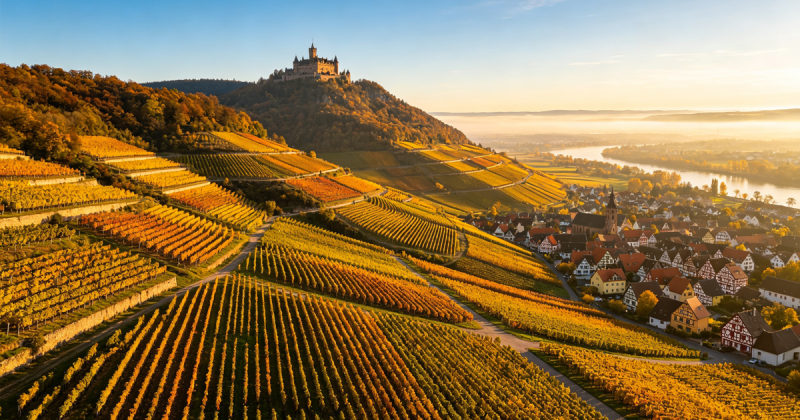
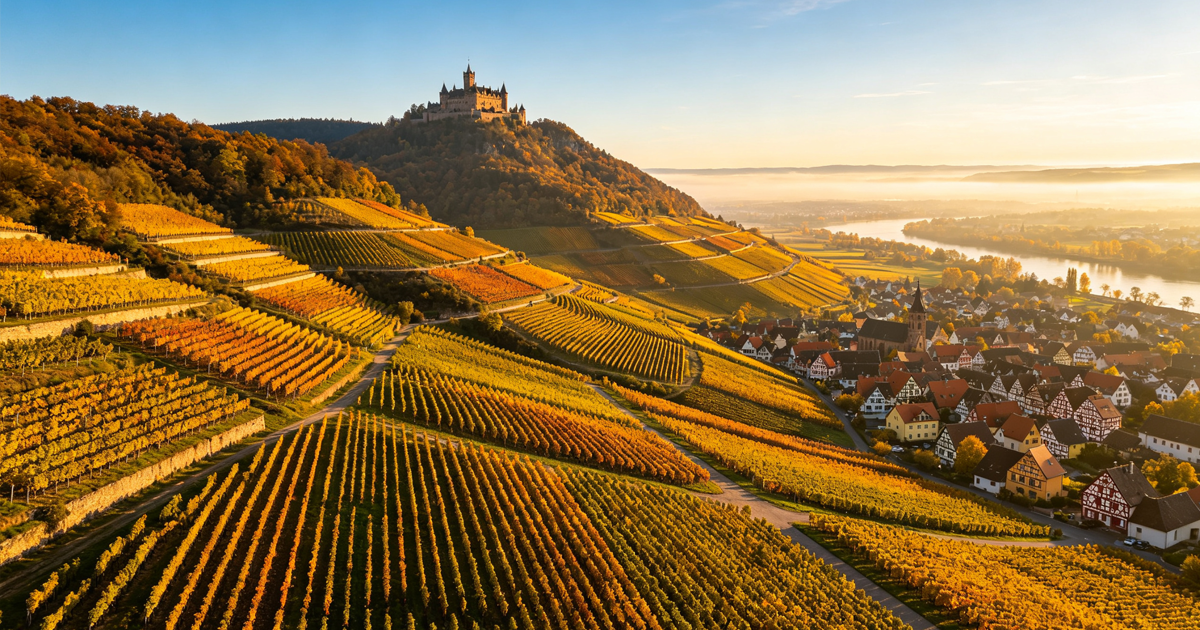




Imagine a wine region that changed nationalities four times in 75 years. French since 1648, annexed by Germany in 1871, returned to France in 1918, occupied by the Nazis in 1940, French again in 1944. The vines weathered all of it—they’d been there since the Romans. But the people? They learned to make wine that could speak to both sides of the Rhine.
That split identity is baked into every bottle. Alsace produces wines that use German grape varieties, fill tall slender flûtes that look more like Mosel bottles than Burgundy, and print the grape name on the label—a practice that would be illegal in any other French AOC. Yet the wines themselves are unmistakably, unapologetically French in structure: drier, more powerful, more emphatically food-driven than their German counterparts.
Walk into a wine shop looking for a riesling and you’ll find two aisles. One holds bottles that taste of green apple and slate, hovering around 8–9% alcohol, with the word Kabinett or Spätlese on the label. The other holds bottles at 12.5–13.5%, bone-dry, with a minerality that reads less like apple and more like crushed stone and petrol—the stuff that serious riesling drinkers chase. That second aisle is Alsace.
Ninety percent of Alsace’s production is white. It is, by that measure, the most white-dominant fine-wine region in France. It’s also, perversely, one of the most ignored by American wine drinkers—who hunt for white Burgundy at $80 a bottle while a Grand Cru Alsace Riesling with twenty years of life ahead of it sits on the next shelf for $45.
This is going to change. Climate change is pushing Burgundy’s ripeness into unprecedented territory while Alsace’s cool nights and limestone slopes keep their grip on acidity. The wines that once seemed austere to Palates raised on buttered Chardonnay now read as precise, electric, and unusually food-flexible for their complexity. If you haven’t bought a bottle of Alsace Riesling in the last five years, you’re about to.
Key Takeaways
- Alsace Riesling is dry. Unlike German Riesling, which often stops fermentation with residual sugar, Alsace Riesling ferments to completion—12.5–13.5% alcohol, bone-dry, built for food.
- The grape variety is on the label. Alsace is the only French AOC that labels by varietal (Riesling, Gewurztraminer, Pinot Gris, Muscat). It’s a Germanic practice that survived four border changes and makes buying easier.
- 51 Grands Crus cover a geological patchwork. In a 120-km strip, the soil switches from granite to limestone to volcanic schist within a kilometer. The Grand Cru system tells you where the grapes grew—but the producer’s name still matters more.
- Vendanges Tardives (VT) and Sélection de Grains Nobles (SGN) are the quality multipliers. VT means late-harvest (can be dry or sweet). SGN means botrytis-selected, always sweet, always rare, and some of the most age-worthy dessert wines on earth.
- The best Alsace wines are absurdly undervalued. Grand Cru Riesling that ages 20+ years sells for $40–$70—the same quality in white Burgundy would cost $150–$300.
- Crémant d’Alsace is the best non-Champagne value in French bubbles. Traditional method, $18–$25, indistinguishable from entry-level Champagne in blind tastings. Buy it by the case.
The Rain Shadow
The Vosges Mountains are not dramatic. The highest peak in the range, Grand Ballon, barely exceeds 1,400 meters—half the elevation of respectable Alps. But the Vosges don’t need height. They’re positioned perfectly to catch the prevailing westerly winds.
When Atlantic moisture rolls across France and hits the Vosges, physics takes over. The air rises, cools, condenses. Rain pounds the western slopes. By the time that same air mass descends the eastern side, it’s been wrung dry. Colmar, the wine capital of Alsace, receives about 530 millimeters of precipitation annually—making it one of the driest cities in France. Bordeaux, for comparison, gets 950. Burgundy, 750.
The sun, meanwhile, gets a clean shot. The Vosges block the cloud cover along with the rain. Alsace basks in roughly 1,800 hours of sunshine per year—comparable to the Languedoc, hundreds of kilometers to the south. Long, slow ripening with cool nights preserves acidity. It’s a formula that shouldn’t work on paper—a northern region with southern sunshine and desert-level rainfall—but it does.
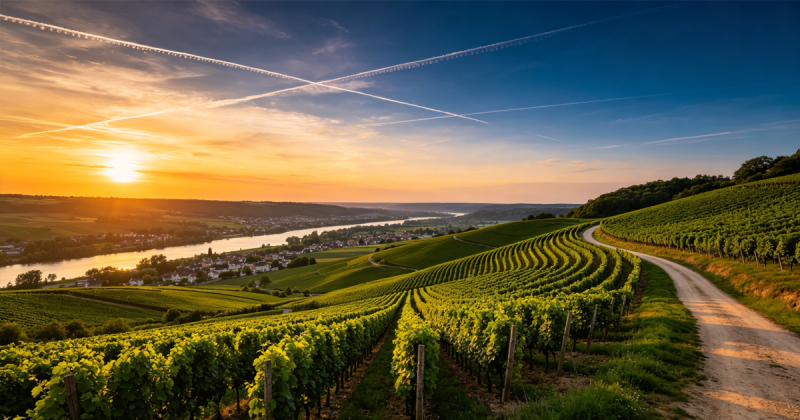
The vineyards themselves sit on a narrow strip that runs roughly 120 kilometers north to south, rarely more than a few kilometers wide. The best sites occupy the steep, east- and southeast-facing slopes between 200 and 400 meters of elevation. Below that, the alluvial plain is too fertile—good for corn, useless for serious wine. Above that, it’s forest. The sweet spot is a band of hillside where vines have to work.
That band, however, is geologically unhinged. The Vosges and the Rhine Graben are products of the same tectonic drama that created the Alps—the African and Eurasian plates colliding, buckling, faulting. The result is a geological mosaic compressed into a tiny area. Walk the Grand Cru vineyards and the soil can switch from granite to limestone to marl to sandstone to volcanic schist within a kilometer. Thirteen major soil types have been catalogued across the region. A riesling grown on granite in the Brand vineyard tastes nothing like a riesling grown on the marl-limestone of Schoenenbourg, less than twenty kilometers south. The mineral signature is that specific.
The key soil types and what they produce:
- Granite (Brand, Sommerberg, Schlossberg): Riesling’s highest expression. Taut, vertical, citrus-and-stone-driven. Wines that feel carved rather than grown.
- Limestone (Rosacker, Furstentum): Broader, more textural. White peach, smoke, saline finish. Pinot Gris excels here.
- Marl-limestone (Schoenenbourg, Mambourg): The most complete wines. Structure, weight, aromatic complexity. Riesling and Gewurztraminer both thrive.
- Sandstone (Kitterlé, Saering): Lighter, aromatic, earlier-maturing. Gewurztraminer’s most fragrant expressions.
- Volcanic (Rangen): The southernmost Grand Cru. Dark, ferrous, almost savage. Riesling and Pinot Gris of extraordinary concentration and longevity.
No other French wine region packs this much geological variety into this little space. Burgundy’s limestone monoculture it is not.
One more thing about the climate: the Mistral doesn’t reach Alsace, but the region has its own wind—a north-to-south breeze that dries the grapes after rain and suppresses rot. In a region that makes so much late-harvest wine, this matters enormously. A damp September can ruin a vintage everywhere else; in Alsace, the wind often saves it.
What the Label Tells You (and Why It Breaks French Law)
The French AOC system has an organizing principle: the place matters more than the grape. You don’t buy a bottle of “Chardonnay” from Burgundy. You buy a Meursault, or a Chablis, or a Puligny-Montrachet. The commune, the vineyard, the climats—these are the units of meaning. The grape variety is rarely mentioned. It’s assumed you know.
Alsace ignores this. Buy a bottle of Alsace wine and the varietal name is front and center: Riesling, Gewurztraminer, Pinot Gris, Muscat. If it’s a blend—usually of lesser varieties like Pinot Blanc, Auxerrois, Sylvaner—the label may say “Edelzwicker” or “Gentil” or simply bear the producer’s proprietary name.
Why the exception? Partly Germany. Fifty years of German rule (1871–1918) embedded the Germanic practice of labeling wines by grape and ripeness. But the habit survived France’s return for a pragmatic reason: Alsace grows a small number of highly distinctive varieties, and naming them directly tells the buyer more than naming the village would. A “Riquewihr” doesn’t tell you much if you don’t know what’s in the bottle. “Riesling” does.
The AOC Hierarchy
The legal framework has three tiers:
| Tier | Share of Production | What It Means |
|---|---|---|
| Alsace AOC | ~74% | The broad regional appellation. Covers white (varietal or blend), red (Pinot Noir only), and rosé. Most entry-level and mid-range wines live here, including many that would be classified higher if producers bothered with the paperwork. |
| Alsace Grand Cru AOC | ~5% | 51 named vineyards (lieux-dits), each an independent appellation. Stricter yields, hand-harvesting, minimum ripeness, and only four permitted grapes: Riesling, Gewurztraminer, Pinot Gris, and Muscat. A handful of Grands Crus (Altenberg de Bergheim, Kaefferkopf, Zotzenberg) permit blends. |
| Crémant d’Alsace AOC | ~21% | Traditional-method sparkling wine. Same process as Champagne, different grapes—typically Pinot Blanc, Auxerrois, and/or Pinot Noir, with Riesling often used for the best examples. Roughly 35 million bottles produced annually. |
The Grand Cru system deserves a closer look, because it’s both Alsace’s greatest asset and its most maddening feature.
51 Grands Crus: Too Many, or Just Enough?
The first Alsace Grand Cru—Schlossberg—was recognized in 1975. The last—Kaefferkopf—came in 2007. Thirty-two years to designate 51 vineyards. The process, to put it mildly, was political.
Critics make two complaints. First: 51 crus spread across a 120-kilometer strip is a lot. Burgundy has 33 Grands Crus in the Côte d’Or for a much smaller area. Some Alsace Grands Crus—unfairly or not—lack the internal consistency and reputation to justify the designation. Second: the boundaries were sometimes drawn to include cooperative and large-producer vineyards rather than following geological logic exclusively. A single Grand Cru can stretch across multiple soil types, diluting the terroir story.
Defenders—and I count myself among them—note that the system has been steadily improving. The 2011 reform gave each Grand Cru its own AOC status with specific production rules. Many have délai de garde (minimum aging) requirements. The best Grands Crus—Rangen, Schlossberg, Schoenenbourg, Brand, Rosacker, Sommerberg, Furstentum, Goldert, Mambourg, Kitterlé—produce riesling and pinot gris that compete with top Grand Cru Burgundy at a third of the price.
The practical rule: a Grand Cru label is a positive signal, but not a guarantee. The producer’s name tells you far more. A basic Trimbach Riesling (from no Grand Cru at all) will almost always outperform a Grand Cru Riesling from a cooperative. This is a region where you buy the winemaker first, the vineyard second.
The Other Quality Signal: Vendanges Tardives and SGN
Apart from the Grand Cru system, Alsace has two ripeness-based designations that operate as an independent quality axis. A wine can be Grand Cru. It can be Vendanges Tardives. It can be both. The two systems don’t compete; they stack.
Vendanges Tardives (VT): “Late harvest.” Grapes are left on the vine past normal ripeness, concentrating sugar and flavor. The minimum sugar levels are specified by law—considerably higher for Gewurztraminer and Pinot Gris than for Riesling and Muscat. VT wines can be dry, off-dry, or sweet, depending on the producer and the vintage. The law doesn’t mandate sweetness; it mandates ripeness. A Trimbach VT Riesling might be essentially dry—the ripeness shows as texture and weight rather than sugar. A Zind-Humbrecht VT Pinot Gris might be unapologetically lush.
Sélection de Grains Nobles (SGN): Botrytis-selected. Workers pass through the vineyard multiple times over several weeks, picking individual berries that have been attacked by noble rot (Botrytis cinerea). The sugar concentration is extreme—minimums roughly double those of VT. The wines are always sweet, always rare, always expensive. A single SGN cuvée might represent the labor of five or six separate harvest passes. Production is measured in hectoliters, sometimes in individual barrels. The best SGNs—Hugel’s Gewurztraminer SGN from the 1976 vintage, or Zind-Humbrecht’s Clos Jebsal SGN—can age for half a century and emerge tasting of apricot, honey, saffron, and stone.
The catch: VT and SGN production are entirely dependent on autumn weather. Botrytis needs morning mist followed by afternoon sun—conditions that don’t happen every year. SGN is made in perhaps one vintage out of four on average. VT might appear in three. When you see a bottle, buy it. There won’t be another for a while.
What’s in the Bottle
Riesling: The Argument for Alsace
If you drink German riesling and you drink Alsace riesling, you already know the difference. If you don’t, here it is: Alsace riesling is dry.
Not “mostly dry.” Not “off-dry with high acid so it tastes dry.” Dry. As in: the fermentation ran until there was nothing left for the yeast to eat. Residual sugar levels are routinely below 4 grams per liter—the threshold at which human palates stop detecting sweetness.
What you get instead is structure. Alsace riesling at 12.5–13.5% alcohol is a wine of vertical power—steely, mineral, with a mid-palate density that German riesling, built around lower alcohol and higher acid-sugar tension, doesn’t pursue. The aromatics are citrus and stone fruit in youth, evolving into the famous “petrol” note (TDN, technically—trimethyldihydronaphthalene) after five to ten years of bottle age. That petrol note, which some drinkers find off-putting, is to Alsace riesling what truffle is to Barolo: a sign the wine is entering its prime.
Grand Cru riesling from top sites can age 15–40 years. Trimbach’s Clos Sainte Hune—widely considered the world’s greatest dry riesling—routinely goes 30+. A 1990 opened in 2024 was still vibrant, with decades ahead.
Gewurztraminer: Love It or Fight It
No wine grape polarizes drinkers quite like Gewurztraminer. It is unsubtle by design: rose petal, lychee, Turkish delight, clove, ginger. The aromatics are so intense they can register as perfume counter. Critics call it a one-trick pony. Devotees call those critics cowards.
Gewurztraminer—“spice Traminer”—has low acidity relative to other Alsace grapes and tends toward high alcohol (14%+ is common). This makes it a particular challenge for winemakers: without careful handling, it can feel flabby and hot. When it works—and it works most reliably from marl-limestone Grands Crus like Hengst and Goldert—the result is a wine of extraordinary aromatic complexity and texture, less about refreshment than about sensation.
The great trick of Gewurztraminer is that it pairs with foods that destroy other wines. Munster cheese, the famously pungent washed-rind cheese of Alsace, was made for Gewurz. So was choucroute garnie—the region’s signature dish of sauerkraut, sausages, and smoked pork. Spicy Thai, Indian, and Sichuan cuisines that would murder a delicate white Burgundy are handled easily by Gewurztraminer’s aromatic firepower. It’s a wine that solves pairing problems, even if you wouldn’t want to drink it every night.
Pinot Gris: The Smoke and the Weight
Pinot Gris from Alsace is not Pinot Grigio. It’s a different animal entirely—darker in the glass, fuller-bodied, with a smoky, almost savory quality that makes it one of the region’s most food-versatile wines.
The old name was Tokay d’Alsace—abandoned in 2007 after a legal dispute with Hungary, which understandably wanted exclusive rights to the name Tokaji. The old-timers still call it Tokay, and if you find a pre-2007 bottle, that’s what the label will say.
Good Alsace Pinot Gris smells of smoke, pear, honey, and underbrush. The palate has weight—more than riesling, less than gewurztraminer—with a characteristic oiliness that coats the mouth. The best versions come from limestone-rich soils (Rosacker, Furstentum) and volcanic sites (Rangen), where the grape’s natural richness is cut by mineral tension. VT and SGN versions are legendary: a 20-year-old Pinot Gris SGN from Zind-Humbrecht’s Clos Jebsal can be one of the most complex sweet wines on earth.
Muscat: The One You Drink First
Muscat is the aperitif grape—bone dry, intensely grapey, smelling and tasting exactly like fresh Muscat grapes. It’s the least planted of the four noble varieties and the one that demands to be drunk youngest. Within two to three years of the vintage, its primary aromatics have begun to fade. After five, it’s a shadow.
Alsace Muscat is not Muscat from anywhere else. It’s not the sweet, fizzy Moscato d’Asti of Piedmont. It’s not the fortified Muscat de Beaumes-de-Venise from the southern Rhône. It’s dry, light, and irreducibly fresh. Serve it cold, with asparagus or goat cheese or on its own before dinner. Drink it within eighteen months of release. Don’t cellar it. Don’t overthink it. It’s the one wine in Alsace that doesn’t ask questions.
The Workhorses: Pinot Blanc, Sylvaner, Auxerrois
Not every Alsace wine is meant to be meditated upon. Some are meant to be opened on a Tuesday.
Pinot Blanc is the everyday white of Alsace. Neutral, refreshing, lightly floral, with a pleasant creaminess on the finish. Often the base for Crémant d’Alsace. Many of the wines you’ve seen labeled simply “Alsace” or with a proprietary name (“Gentil,” “Cuvée Tradition”) are predominantly Pinot Blanc. It asks nothing of the drinker except enjoyment.
Sylvaner is Pinot Blanc’s leaner, more interesting cousin. Grown on sandy soils, it produces wines of surprising mineral precision—green apple, white flowers, a saline finish. It was once Alsace’s most planted grape and is now making a modest comeback among serious producers. If you see a Sylvaner from a top estate (Weinbach, Ostertag), buy it. It will cost $18 and taste like $35.
Auxerrois is soft, round, and tends toward lower acidity. Rarely bottled solo; almost always blended into Pinot Blanc-based wines to add weight and approachability.
Pinot Noir: Alsace’s Red Secret
Yes, red wine exists in Alsace. Pinot Noir is the only red grape permitted in the AOC (the Grand Cru system doesn’t allow it at all for still wine, though a few producers are pushing for change). Historically, Alsace Pinot Noir was thin, pale, and forgettable—a rosé pretending to be a red.
That’s changed dramatically in the last fifteen years. Warming summers have pushed ripeness into Burgundy-like territory. A handful of producers—Albert Mann, Muré (Clos Saint Landelin), Zind-Humbrecht, Marcel Deiss—are now making Pinot Noir with real structure and complexity. The best examples come from limestone soils in the north, around Ottrott and Barr. Prices are rising accordingly, but they’re still a fraction of what you’d pay for equivalent-quality Burgundy.
Crémant d’Alsace: France’s Best-Kept Sparkling Secret
At roughly 35 million bottles annually, Crémant d’Alsace is the region’s largest export and France’s best-value traditional-method sparkling wine. The production method is identical to Champagne: secondary fermentation in bottle, minimum aging on lees, disgorgement. The difference is the grapes (Pinot Blanc dominates, with Auxerrois, Pinot Noir, Riesling, and Chardonnay permitted) and the terroir (the same dry, sunny slopes that produce Alsace’s still wines).
What you get for $18–$25 is a genuinely serious sparkling wine: dry, crisp, appley, with fine bubbles and enough body to hold up to food. The best examples (Lucien Albrecht, Dopff au Moulin, Domaine Mittnacht Frères) are indistinguishable from entry-level Champagne in blind tastings. Crémant d’Alsace rosé, made entirely from Pinot Noir, is especially good.
Where to Start
The Short List of Producers
Alsace runs on producer reputation more than any other French region. The quality gap between the best and the average is wider here than in Bordeaux or Burgundy—partly because entry barriers are low (you can make drinkable Alsace wine from the flat plain) and the ceiling is very high (you can make transcendent wine from the Grand Cru slopes).
These are the names to know, organized by what they stand for:
The Aristocrats — historic families, unwavering consistency, wines built for the cellar:
- Trimbach: Riesling in its Platonic form. Clos Sainte Hune is the reference-point dry riesling on earth. Cuvée Frédéric Émile (from Geisberg and Osterberg) is the value alternative—roughly $60 for 20-year wine. Everything they make is bone-dry by philosophy.
- Hugel: Continuously family-run since 1639. The traditionalist anchor. Their “Jubilee” line and SGNs are the flagships. Less aggressively dry than Trimbach, more accessible young.
- Léon Beyer: Old-school, emphatically dry, sometimes austere young. The Comtes d’Eguisheim line ages brilliantly.
The Domaines — biodynamic, terroir-obsessed, wine that speaks of the soil:
- Zind-Humbrecht (Olivier Humbrecht MW): The most important domaine in Alsace, full stop. 41 hectares, four Grands Crus (Rangen, Goldert, Hengst, Brand). Biodynamic since the 1990s. The wines are powerful, often bone-dry, sometimes with residual sugar—Humbrecht lets the vintage decide. Their Rangen Riesling and Pinot Gris are benchmarks.
- Weinbach (Faller family): Precision and elegance. The Clos des Capucins monopole in Kaysersberg is the heart of the estate. Schlossberg Riesling, Furstentum Pinot Gris, and the Altenbourg Gewurztraminer are as good as anyone’s.
- Marcel Deiss (Jean-Michel Deiss): The philosopher-rebel. Deiss abandoned varietal labeling decades ago, choosing instead to make field blends—complantation, he calls it—from his Grand Cru holdings. The wines (Altenberg de Bergheim, Schoenenbourg, Mambourg) are unlike anything else in Alsace: dense, complex, often with multiple grapes co-fermented in a single vineyard, with a textural complexity that challenges the varietal-labeling orthodoxy.
- Josmeyer: Organic/biodynamic since 2004. Pure, precise, often with striking aromatic lift. The Hengst Riesling and Brand Pinot Gris are especially fine.
- Ostertag (André Ostertag): Biodynamic pioneer. Known for Pinot Gris that rivals red wine in complexity and ageability. The single-vineyard wines (Muenchberg, Fronholz, Heissenberg) are full-throttle expressions.
The Value Hunters — names you can buy blind:
- Albert Boxler: Granite Riesling from the Sommerberg vineyard. Prices are absurd for the quality—$25–$40 for wine that drinks at twice the cost.
- Barmès-Buecher: Seven generations of family farming. The biodynamic wines strike a balance between richness and precision that makes them unusually approachable.
- Kuentz-Bas: Historic house, under-the-radar pricing. Their Grand Cru Eichberg and Pfersigberg bottlings are consistently underpriced for the quality.
- Schlumberger: The largest Grand Cru owner in Alsace (over 130 hectares across Kitterlé, Saering, Kessler, and Spiegel). Their scale allows pricing that smaller domaines can’t match. The Kitterlé Riesling is the standout.
Price Tiers
One of the quiet pleasures of drinking Alsace is that the prices haven’t caught up to the quality. This is not a region where you need to spend $100 to get something serious.
| Price Range | What to Expect |
|---|---|
| $15–$22 | Entry-level varietal wines (Pinot Blanc, Sylvaner, basic Riesling) from quality producers. Crémant d’Alsace. Perfectly good midweek wine. |
| $22–$40 | The sweet spot. Single-vineyard Riesling and Pinot Gris from top producers, entry-level bottles from the elite domaines, very good Crémant. This is where Alsace destroys Burgundy on value. |
| $40–$70 | Grand Cru Riesling from leading domaines. Trimbach Cuvée Frédéric Émile. Weinbach Schlossberg. Ostertag Muenchberg. Serious, cellar-worthy white wine at a price Burgundy abandoned a decade ago. |
| $70–$150 | Flagship wines. Clos Sainte Hune (Trimbach). Zind-Humbrecht Rangen. Hugel Jubilee. VT wines from top producers. These compete with great white Burgundy in quality and complexity. |
| $150–$500+ | SGN bottlings. Ancient-vineyard selections. Auction lots of legendary vintages (Hugel 1976 SGN, Trimbach 1990 Clos Sainte Hune). This is collector territory. |
Vintage Notes
Alsace has the same broad vintage pattern as most of northern France—warmer years produce riper, more generous wines; cooler years produce leaner, more age-worthy wines. But the region’s dry autumn weather gives it an edge in difficult years that Bordeaux and Burgundy don’t have.
Outstanding (buy without hesitation):
- 2019: The current benchmark. Balanced, concentrated, with extraordinary freshness. Rieslings have decades ahead. A reference vintage.
- 2016: Classic structure. Cool nights, long hang time. Elegant rather than powerful. Wines are entering their drinking window now.
- 2015: Warm, ripe, generous. More approachable young than 2016. Buy for current drinking.
- 2010: Legendary for Riesling. Taut, mineral, built for the ages. Still evolving.
Very good (buy for value, some will surprise you):
- 2020: Fresher and leaner, with surprising tension. A sleeper vintage—less hyped than 2019, but very good.
- 2017: Frost-reduced yields concentrated quality. The wines punch above their reputation.
- 2012: Elegant, balanced. Drinking beautifully now at ten years.
Proceed with caution:
- 2021: Late frost devastated yields. Some excellent wines were made where grapes survived, but quantities are tiny and prices high. Buy from top producers only.
- 2014: Cool and rainy. Diluted wines except from the very best domaines.
Current releases (2022, 2023): 2022 was warm and generous, producing early-drinking wines with broad appeal. 2023 is promising—early reports suggest a return to classic structure. The 2022s are hitting shelves now; the 2023s will start arriving in 2025.
The practical takeaway: Alsace is a region where vintage matters less than producer, much like Burgundy. A “difficult” year from Trimbach or Zind-Humbrecht is almost always more rewarding than a “great” year from a négociant blender. Buy the name, then check the year.
Alsace at the Table
Mentioning food pairing feels obligatory in a region where the wines are literally designed for meals, but the real story is simpler than any chart.
Riesling goes with anything that came out of the water—oysters, sole, trout, scallops—and anything pickled or fermented. The acidity cuts through brine and fat simultaneously. Choucroute garnie and Riesling is one of the canonical pairings in all of wine.
Pinot Gris handles the in-between territory: roasted chicken, pork loin, mushroom dishes, anything with cream sauce. Its weight and smoke make it the white wine for people who think they only drink red.
Gewurztraminer meets the strongest flavors at the table and doesn’t flinch. Munster. Liverwurst. Thai curry. Szechuan peppercorns. Foie gras. Serve it colder than the other whites—48–50°F—and let it warm in the glass.
Crémant d’Alsace is the utility player. Aperitif? Yes. Oysters? Yes. Fried food? Yes. Tuesday night? Yes.
Frequently Asked Questions
What’s the difference between Alsace Riesling and German Riesling?
Dryness. Alsace Riesling is fermented to completion, resulting in 12–13.5% alcohol and very low residual sugar. German Riesling—particularly at the Kabinett and Spätlese levels—often retains sweetness balanced by acidity and typically carries lower alcohol (7–11%). The flavor profiles also diverge: Alsace leans toward citrus, stone, and petrol; Germany toward green apple, peach, and slate. Alsace Riesling is a dinner wine. German Riesling can be, too—but it’s also often an aperitif.
Why does the bottle look German?
The tall, slender flûte d’Alsace is a legal requirement—all Alsace AOC wines must use this bottle shape. Its origins are indeed German, inherited during the period of German rule. The shape has zero effect on wine quality but makes Alsace bottles instantly recognizable on a shelf.
What does “Grand Cru” mean in Alsace?
A Grand Cru designation means the grapes came from one of 51 named vineyard sites with stricter production rules: lower yields, hand-harvesting, minimum ripeness, and only four permitted grape varieties (Riesling, Gewurztraminer, Pinot Gris, Muscat). It is a geographically defined quality tier, but the producer’s name matters more than the Grand Cru status alone. A mediocre producer’s Grand Cru is worse than Trimbach’s basic Riesling.
Is all Alsace wine sweet?
No. Approximately 80% of Alsace production is dry white wine. The region’s reputation for sweetness comes from its late-harvest specialties—Vendanges Tardives and Sélection de Grains Nobles—which are a tiny percentage of total production. Even among VT wines, many are fermented to dryness by top producers. If you want to be sure a bottle is dry, look for producers known for a dry style (Trimbach, Léon Beyer, Josmeyer) or check the alcohol—anything above 13% is almost certainly dry.
How long can I age Alsace wine?
Riesling from top Grands Crus: 10–30+ years. Grand Cru Pinot Gris and Gewurztraminer: 8–20 years. VT wines: 15–40+ years. SGN: 30–50+ years. Entry-level varietal wines: drink within 3–5 years. Crémant: drink within 2 years of purchase.
Why is Alsace wine so undervalued?
A combination of factors. The tall bottle confuses consumers who associate that shape with cheap German imports from the 1970s–80s. The varietal labeling makes it hard to market alongside French AOC wines, which are sold by place rather than grape. And until recently, Alsace lacked a clear quality hierarchy—the Grand Cru system came decades later than Bordeaux’s 1855 Classification or Burgundy’s 1936 AOC pyramid. The result is a region making world-class wines that the market persistently under-prices. Buy accordingly.
Last updated: June 2026. Vintage assessments reflect market conditions and consensus as of this date.

No comments yet