



Riesling: The Ultimate Guide to the World’s Greatest White Grape
Key Takeaways
- Riesling is the most transparent white grape on the planet — it translates vineyard, soil, and climate into the glass with a precision no other variety can match, yet ranges from bone-dry (Trocken) to intensely sweet (TBA)
- Germany is Riesling’s spiritual home, with 24,233 hectares — roughly 40-45% of the world’s total plantings across ~51,000 global hectares
- The first documented mention dates to March 13, 1435, when Count John IV of Katzenelnbogen purchased six Riesling vine cuttings for 22 solidi in Rüsselsheim
- That “petrol” note in aged Riesling is TDN (1,1,6-trimethyl-1,2-dihydronaphthalene) — a compound derived from carotenoid precursors in the grape skins, triggered by UV sunlight exposure
- Riesling pairs with spicy food better than almost any other wine because its residual sugar neutralizes capsaicin heat while its high acidity refreshes the palate — and its typically low alcohol doesn’t intensify the burn
Introduction
If you think Riesling is just a sweet wine your grandmother drinks, you’re missing out on the most versatile white grape on the planet.
I mean that literally. No other white variety can produce world-class wines across such an absurd spectrum. At one end: a laser-focused, bone-dry 7% ABV Kabinett from a Mosel slate slope. At the other: an unctuous, honeyed Trockenbeerenauslese that sells for more than First Growth Bordeaux. Riesling does both — and everything in between — without breaking a sweat.
Here’s a story about perception. In 2023, a friend of mine — let’s call him Thomas — hosted a blind tasting for his wine club in Hamburg. He poured a 2015 Keller Abtserde GG (a dry Riesling from Rheinhessen that retails for around €150) alongside a well-known Meursault Premier Cru at a similar price point. Twelve tasters. Eleven preferred the Riesling. But when he revealed the bottles, five of them genuinely looked embarrassed. “I thought I didn’t like Riesling,” one said. “I thought Riesling was sweet.”
That’s the Riesling paradox in a nutshell. It’s simultaneously the greatest white grape many wine lovers have never properly explored — and the one most weighed down by outdated stereotypes. That’s what this guide is for. Whether you’re a complete beginner who can’t decode a German label or an intermediate enthusiast looking to understand why aged Riesling smells like petrol, I’ll walk you through everything: the history, the science, the six major regions, the sweetness code, food pairing, and exactly which bottles to buy at every price point.
By the time you finish reading, you’ll know more about Riesling than 95% of wine drinkers. And you’ll have a shopping list.
Want to explore where Riesling started? Our German wine regions guide covers all 13 Anbaugebiete in depth — the essential companion to this article.
1. What Is Riesling? — Name, Origins & History
The Name and the First Record
The earliest confirmed written record of Riesling appears in a cellar log dated March 13, 1435 — a fact preserved in the archives of the Deutsches Weininstitut. Count John IV of Katzenelnbogen — a powerful noble whose territory straddled the Rhine near modern-day Rüsselsheim — recorded the purchase of six Riesling vine cuttings for the sum of 22 solidi from a seller named Klaus Kleinfish. That’s it: six vines, a handful of coins, and a line in an account book. From that modest beginning, the grape would go on to colonize the world’s greatest white wine vineyards.
The name itself likely derives from the German verb riesen (to fall or slip) or the older ruozen (to trickle), possibly referencing the variety’s tendency to produce small, uneven crops if conditions aren’t right. Other theories link it to Riesling as a corruption of Rissling, referring to the dark wood (Riß) of the vine’s canes.
But names aside, the grape’s genetic story is where things get interesting.
DNA: The Accidental Cross
In 1998, Austrian researchers at the Klosterneuburg viticultural institute used DNA profiling to partially decode Riesling’s parentage. The results confirmed that one parent is Gouais Blanc (known in German-speaking regions as Heunisch weiss) — an ancient, widely scorned variety that is, improbably, the genetic parent or grandparent of dozens of noble grapes, including Chardonnay, Gamay, and the parents of Cabernet Sauvignon. Riesling’s other parent appears to be a wild vine, possibly a cross between a wild Vitis vinifera ssp. sylvestris and an already-cultivated variety like Traminer.
This is classic grape genetics: take one undistinguished workhorse parent, add an unknown wildling, and end up with a variety that expresses terroir with more precision than almost anything else in viticulture. Riesling doesn’t have Cabernet Franc or Pinot Noir in its family tree. It’s something stranger — a happy accident of the Rhine Valley.
The Spätlese Accident That Changed Everything
🕮 Mini-Story: The Courier Who Invented Spätlese
It’s autumn 1775 at Schloss Johannisberg, a former Benedictine monastery perched above the Rhine in the Rheingau. The estate — planted exclusively to Riesling since 1720, making it the world’s first single-variety Riesling vineyard — operates under a peculiar rule: harvest cannot begin without written permission from the Prince-Abbot of Fulda, who owns the property.
The courier dispatched with that year’s harvest authorization — the Traubenkurier, or grape courier — never arrives on schedule. Some versions of the legend say his horse was attacked by a wild animal near Mainz. Others suggest he simply lost his way through the forest. Whatever the reason, he’s delayed. For three weeks.
The monks watch in horror as their crop deteriorates. The grapes shrivel on the vine. Botrytis cinerea — noble rot — spreads through the clusters. When the courier finally stumbles through the gates, the monks press the withered, partially-botrytized grapes anyway, expecting disaster.
The resulting wine astounds them. It’s richer, sweeter, more concentrated, and infinitely more complex than anything they’ve ever produced. They’ve accidentally invented Spätlese — “late harvest” — and from this single delayed message, the entire edifice of German Prädikat wine classification (Kabinett → Spätlese → Auslese → BA → TBA) would eventually be constructed.
Schloss Johannisberg’s innovation didn’t stay local. By the late 18th century, Riesling had spread throughout the Rheingau and Mosel. In the 19th century, it achieved something remarkable: the top Rieslings of the Rheingau — particularly from the 1811, 1857, and 1893 vintages — were the most expensive wines in the world, commanding prices that exceeded First Growth Bordeaux and top Burgundy at auction.
The Blue Nun Era and the Reputation Crash
This golden age didn’t last. The mid-20th century brought two world wars, economic devastation, and a German wine industry that rebuilt around volume rather than quality. By the 1970s and 80s, Blue Nun — a mass-market, slightly sweet blend using Riesling (and later, other white grapes) — was shipping 24 million bottles per year to over 90 countries.
Blue Nun was a marketing triumph and a reputation disaster. For millions of casual wine drinkers, especially in the UK and US, it defined what “German Riesling” meant: cheap, sweet, and forgettable. The stereotype stuck for decades. Even today, watch what happens at a dinner party when someone says, “I brought a Riesling.” The pause before “…oh, I don’t usually like sweet wines” remains predictable.
The comeback has been slow but decisive. A new generation of German winemakers — Keller, Dönnhoff, Wittmann, Haag, thousands of others — has spent the past 20 years proving that Riesling at its best is not sweet, not cheap, and absolutely not forgettable. The wine world has noticed. The stereotype hasn’t fully caught up, but the bottles speak for themselves.
2. Viticulture — What Makes Riesling Unique
Riesling is not an easy grape to grow. It buds late — typically in late April or early May in the Northern Hemisphere — which protects it from spring frosts (a significant advantage in cool-climate regions). But it also ripens late, often not reaching full phenolic maturity until October or even November in cooler sites. This long, slow ripening period is part of Riesling’s magic: the grape accumulates flavor complexity and retains acidity simultaneously, a balancing act that warm-climate varieties rarely pull off.
Three characteristics define Riesling in the vineyard:
- Thin skins. Riesling berries have exceptionally thin skins, making them vulnerable to rot, disease, and sunburn — but also contributing to the grape’s aromatic intensity (many aromatic compounds reside in or just beneath the skin).
- High natural acidity. Riesling retains malic and tartaric acid even as sugars accumulate, creating the structural backbone that allows sweet Rieslings to taste balanced and dry Rieslings to age for decades.
- Terroir transparency. This is the big one. Riesling is, by general agreement among wine professionals, the most terroir-transparent white grape on earth. Change the soil, and you change the wine — radically.
How Soil Shapes the Glass
| Soil Type | Region Example | What It Does to Riesling |
|---|---|---|
| Blue/grey Devonian slate | Mosel (Germany) | Electric acidity, smoky-mineral notes, white peach, lightness of body |
| Red slate / quartzite | Rheingau (Germany) | More structure, riper stone fruit, broader shoulders |
| Limestone / loess | Rheinhessen (Germany) | Fuller body, more textural richness, citrus and orchard fruit |
| Granite / gneiss | Wachau (Austria) | Intense minerality, structure, almost savory depth |
| Volcanic / basalt | Nahe (Germany) | Smoky, earthy, sometimes ferrous, with bright acidity |
| Marne calcaire / limestone | Alsace (France) | Fuller, rounder, more overtly fruity, less overt minerality |
This is not subtle. A Mosel Riesling grown on blue slate and a Wachau Riesling grown on gneiss can taste like entirely different grape varieties to an attentive taster. That level of soil expression — what the French call transparence du terroir — is Riesling’s defining superpower.
Climate Change and the Organic Wave
Rising temperatures have been a double-edged sword for Riesling. Warmer autumns mean riper grapes and more reliable dry-wine production — one reason German dry Riesling (especially GG) has surged in quality and reputation since the 2000s. But extreme heat events threaten the delicate aromatics that define the variety. In the Mosel, some producers are experimenting with higher-altitude plantings and canopy management techniques to preserve freshness.
The organic and biodynamic movement has gained particular traction in Riesling-growing regions. Producers like Peter Jakob Kühn (Rheingau), Clemens Busch (Mosel), and Nikolaihof (Wachau) have been farming biodynamically for decades, arguing that Riesling’s terroir transparency makes chemical interventions in the vineyard particularly damaging to the final wine’s expressiveness.
3. The Sweetness Spectrum — From Bone-Dry to Liquid Gold
The Core Concept Most People Get Wrong
Nothing about Riesling trips people up more than sweetness. Here’s the thing that changes everything: Riesling’s naturally high acidity masks sugar.
A Riesling with 20 grams per liter of residual sugar will taste significantly drier than, say, a Viognier with the same amount of sugar, because Riesling’s searing acidity cuts through and balances the sweetness. Your palate perceives “sweetness” as a ratio — sugar to acid — not an absolute number.
This is why you can drink a Mosel Kabinett with 45 g/L of residual sugar and find it refreshing rather than cloying. The acidity (often 8-9 g/L of tartaric acid) creates a tension that makes the wine feel light, precise, and balanced.
The Prädikat System Decoded
The German Prädikat system classifies wines by grape ripeness at harvest — not by sweetness in the finished bottle. This might be the most persistent myth in all of wine, so let me be clear: a Spätlese can be bone-dry (trocken) or sweet, depending on the winemaker’s decision about when to stop fermentation.
| Prädikat | Minimum Must Weight (°Oe) | Literal Meaning | Typical ABV | Style Range |
|---|---|---|---|---|
| Kabinett | 67-82°Oe | “Cabinet” — cellar-worthy | 7-10% | Light, delicate; typically off-dry but increasingly made trocken |
| Spätlese | 76-90°Oe | “Late harvest” | 7.5-12% | Riper, more concentrated; can be bone-dry (trocken) or lusciously sweet |
| Auslese | 83-100°Oe | “Selected harvest” | 7-11% | Hand-selected fully ripe bunches; mostly sweet, occasionally dry (rare, powerful) |
| Beerenauslese (BA) | 110-128°Oe | “Berry selection” | 5.5-8% | Individually selected overripe, often botrytized berries; luscious dessert wine |
| Trockenbeerenauslese (TBA) | 150-154°Oe | “Dried berry selection” | 5-8% | Shrivelled, botrytis-concentrated berries; intensely sweet, honeyed nectar — among the world’s rarest and most expensive wines |
| Eiswein | Same as BA | “Ice wine” | 6-9% | Grapes harvested and pressed while frozen (below -7°C); piercingly sweet yet razor-sharp acidity |
The label words that tell you what’s in the bottle:
| German Label Term | Meaning | Residual Sugar (approx.) |
|---|---|---|
| Trocken | Dry | ≤ 4 g/L (up to 9 g/L if balanced by acidity) |
| Halbtrocken | Off-dry | 4-12 g/L (up to 18 g/L if balanced) |
| Feinherb | Unofficial term, popular in Mosel | Roughly off-dry, acid-driven — “fine bitterness” — sitting somewhere between halbtrocken and lightly sweet |
| Lieblich | Semi-sweet | 18-45 g/L |
| Süß | Sweet | > 45 g/L |
The Quick Trick for Sweetness Detection
If you’re standing in a wine shop staring at a German Riesling and trying to guess whether it’s sweet:
- Alcohol below 9% ABV? Almost certainly has noticeable residual sugar — the fermentation was stopped early.
- Alcohol above 12% ABV? Almost certainly dry — all that sugar fermented out into alcohol.
- Between 9-12%? Could go either way. Look for the trocken or halbtrocken designation.
This isn’t 100% foolproof — some high-acid Spätlese trocken wines clock in at 12.5% while tasting drier than wines with 13.5% from warmer regions — but it’s a reliable starting heuristic.
🕮 Mini-Story: The €12,000 Bottle
In September 2015, at the annual VDP Grosser Ring auction in Trier, a single 750ml bottle of Egon Müller’s 2003 Scharzhofberger Riesling Trockenbeerenauslese sold for €12,000. That’s not a typo. Twelve thousand euros. For one bottle. Half a glass costs roughly the same as a weekend in Paris.
What makes Egon Müller’s TBA so valuable? Start with the vineyard: Scharzhofberg, a south-facing slope in the Saar tributary of the Mosel, with grey slate soils and extremely old, ungrafted Riesling vines. The 2003 vintage was historically hot — the hottest summer in Europe in 500 years at the time. The combination of heat stress and the Saar’s cool nights created tiny yields of intensely concentrated berries that were then individually selected, shriveled by botrytis, and pressed into a wine of almost incomprehensible intensity.
A single berry yields roughly one drop of juice. A single bottle requires the labor of picking through acres of vines, berry by berry, over multiple passes. The wine that results — dark gold, with aromas of honey, dried apricot, saffron, and caramel — can age for a century or more. Egon Müller’s TBA isn’t just a wine. It’s liquid time travel.
4. Flavor & Aroma Profile
Riesling’s flavor profile is a direct function of climate and maturity. Unlike Chardonnay, which can taste similar across regions once it’s been through malolactic fermentation and oak, Riesling shows you exactly where it came from.
The Climate Spectrum
| Climate Zone | Example Regions | Aromatics | Palate |
|---|---|---|---|
| Cold | Mosel Saar/Ruwer, Finger Lakes, Tasmania | Lime zest, green apple, grapefruit pith, white flowers, wet slate | Razor-sharp acidity, ultra-light body, pronounced minerality |
| Cool | Mosel Mittelmosel, Rheingau, Nahe, Clare Valley | Lemon, green pear, white peach, jasmine, flint | High acidity, light-to-medium body, mineral core |
| Moderate | Pfalz, Alsace, Wachau, Kamptal | Ripe lemon, white peach, apricot, honeysuckle, ginger | Medium acidity, fuller body, more textural richness |
| Warm | Rheinhessen (select sites), parts of Australia | Mango, pineapple, ripe peach, candied citrus, honey | Medium acidity, full body, sometimes oily texture |
Want to train your nose? Our AI wine tasting card helps you identify the aromas in your glass — from lime zest to petrol.
TDN: The Petrol Note Explained
If there’s one characteristic that defines Riesling for wine geeks, it’s TDN — 1,1,6-trimethyl-1,2-dihydronaphthalene — the chemical compound responsible for that distinctive petrol, kerosene, or rubber-band aroma in aged Riesling.
Here’s the science, kept simple: Riesling grape skins contain carotenoids (the same family of pigments that make carrots orange). When grapes are exposed to UV sunlight during ripening, these carotenoids break down into precursor molecules. During bottle aging — particularly in warm conditions — those precursors convert into TDN.
This is why:
- Riesling from sunnier vintages tends to develop stronger petrol notes
- Grapes from warmer sites or exposed canopies produce more TDN precursors
- The petrol note becomes more pronounced with bottle age
- Some tasters (especially in German-speaking markets) view strong petrol as a positive, terroir-driven characteristic; others find it off-putting
A light petrol note in a 7+ year-old Riesling is normal and often desirable — it’s a sign of maturity. If it smells like you spilled gasoline at a filling station, that’s a flaw (likely from excessive UV exposure or poor storage). For the full biochemistry behind this phenomenon, the UC Davis Waterhouse Lab has published extensive research on TDN formation and sensory thresholds in Riesling.
The Aging Arc of Riesling
Riesling ages on a different timeline from most white wines. Here’s the rough progression:
| Stage | Timeframe | What You Taste |
|---|---|---|
| Youth | 1-3 years | Primary fruit: green apple, lime, peach. Zippy, energetic, almost effervescent in mouthfeel. |
| Dumb Phase | 3-7 years | The wine closes down. Fruit recedes, aromatics mute. Many drinkers mistake this for a wine “dying.” It’s not — it’s regrouping. |
| Maturity | 7-15 years | Tertiary aromas emerge: honey, beeswax, petrol, dried apricot, ginger. Acidity has integrated. The wine is more complex but less overtly fruity. |
| Full Maturity | 15-30+ years | Deep amber-gold. Aromas of caramel, saffron, dried orange peel, lanolin, mushroom. Profoundly complex. The acidity still holds — barely — but the fruit is a memory, not a presence. |
Not every Riesling is built for 30 years. A basic Kabinett might peak at 5-7 years; a top Grosse Lage GG can cruise past 20. The best TBA can outlast your grandchildren.
5. Global Regions — One Grape, Six Worlds
Riesling is planted on roughly 51,000 hectares globally — according to OIV statistics — with Germany alone accounting for 24,233 hectares, about 45% of the world total. But the grape’s reach extends far beyond its homeland, and each region imprints its own signature.
Germany — The Homeland
Germany isn’t just where Riesling started. It’s still the global capital, producing a wider stylistic range than anywhere else. Five regions dominate:
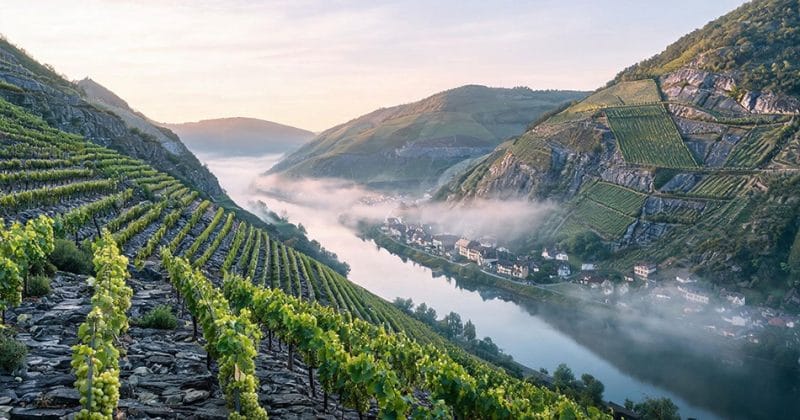
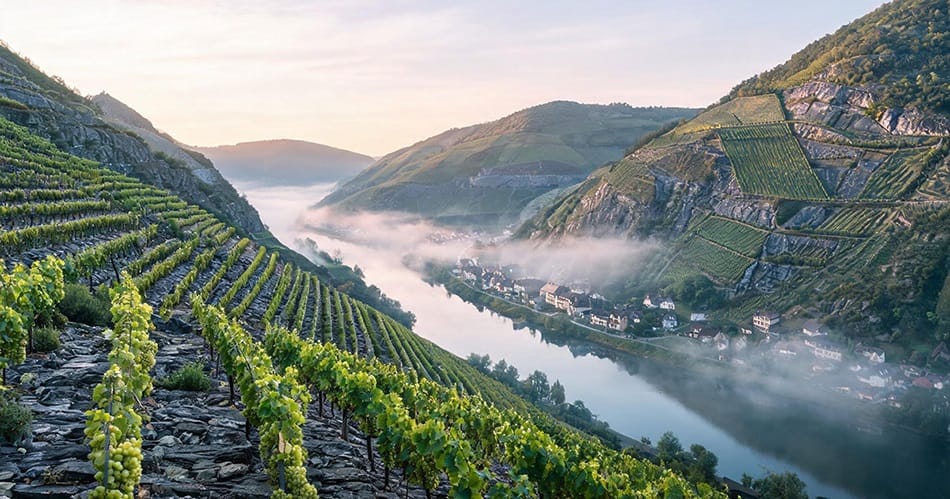
- Mosel (5,330 ha of Riesling): The icon. Blue and grey Devonian slate, impossibly steep slopes, ungrafted old vines. Wines are light (often 7-8.5% ABV), electric with acidity, and defined by white peach, green apple, jasmine, and that signature slate-smoke minerality. The Saar and Ruwer tributaries produce even racier, more mineral-driven wines than the Mittelmosel. Key names: Egon Müller, Joh. Jos. Prüm, Willi Schaefer, Fritz Haag, Clemens Busch.
- Rheingau (~2,400 ha Riesling): The aristocrat. South-facing slopes above the Rhine, with quartzite, slate, and loess soils. Wines are more structured and broader-shouldered than the Mosel — dry Riesling is the focus here, particularly GGs. Key names: Robert Weil, Peter Jakob Kühn, Schloss Johannisberg, Georg Breuer.
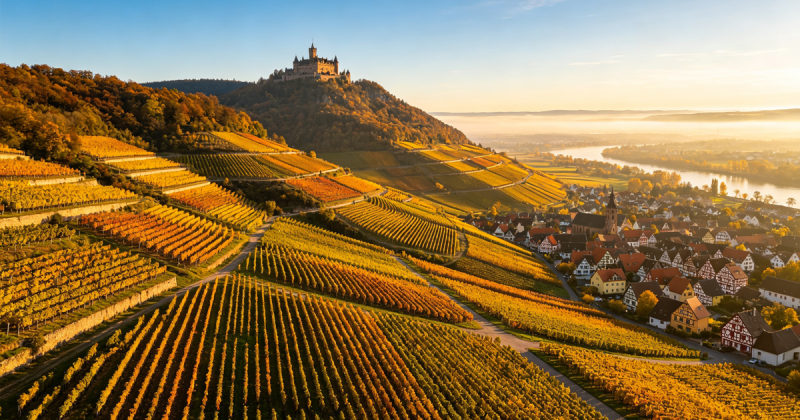
- Pfalz (~5,800 ha Riesling): Germany’s sunniest region. Warmer, drier climate produces fuller-bodied dry Rieslings with riper stone fruit and sometimes a touch of exotic character. The Mittelhaardt — villages like Forst, Deidesheim, and Wachenheim — is the sweet spot. Key names: Müller-Catoir, von Winning, Dr. Bürklin-Wolf.
- Nahe (~1,200 ha Riesling): The overlooked gem. An extraordinary mosaic of soil types — slate, quartzite, volcanic, sandstone, loam — crammed into a small area. Wines range from Mosel-like delicacy to Pfalz-like richness depending on the site. Key names: Dönnhoff (the reference point), Schäfer-Fröhlich, Emrich-Schönleber.
- Rheinhessen (~6,200 ha Riesling): The comeback story. Once synonymous with Liebfraumilch, Rheinhessen is now home to some of Germany’s most exciting dry Rieslings, particularly from the Roter Hang (Red Slope) near Nierstein and the limestone-rich Wonnegau. Key names: Keller, Wittmann, Gunderloch.
🕮 Mini-Story: Keller — The Rebel Who Redefined German Riesling
In 2001, Klaus-Peter Keller and his wife Julia took over the family winery in Flörsheim-Dalsheim, a village in Rheinhessen that few wine collectors had ever heard of. The Kellers had been growing grapes here for generations, but the wines were solid, unspectacular, and sold mostly to local customers.
Klaus-Peter had different ideas. He’d studied at Geisenheim, tasted widely in Burgundy, and believed that Rheinhessen’s limestone soils — long dismissed as second-rate — could produce dry Rieslings that rivaled white Burgundy in complexity and ageability.
He cut yields. He harvested later. He fermented in large old oak Stückfässer rather than stainless steel. And he bottled a wine called G-Max — named after his son Maximillian and his great-grandfather Georg — sourced from old-vine parcels in top sites around the village.
The wine world scoffed. A dry Riesling from Rheinhessen, priced like Grand Cru Burgundy? Absurd.
Then the critics tasted it. Jancis Robinson called it “Germany’s answer to Montrachet.” The 2009 G-Max received the first 100-point score ever awarded to a German dry Riesling. Today, G-Max sells out on allocation within hours and trades on the secondary market for hundreds of euros per bottle. More importantly, Keller’s success sparked a revolution — proving that Rheinhessen could produce world-class dry wines and inspiring an entire generation of young German winemakers.
Alsace — The French Exception
Across the Rhine in Alsace, Riesling takes on a distinctly different personality. Sheltered by the Vosges Mountains — which create a rain shadow making Alsace one of France’s driest wine regions — Alsace Riesling is typically fuller-bodied, higher in alcohol (12-13.5%), and overwhelmingly dry. The granite, limestone, and marl soils of the Alsace foothills produce wines with more overt fruit — ripe lemon, peach, sometimes a smoky gunflint note — and less of the ethereal delicacy of the Mosel.
Alsace’s Grand Cru system identifies 51 superior vineyard sites, though Riesling is only permitted in a subset of these. The categories Vendanges Tardives (VT, late harvest) and Sélection de Grains Nobles (SGN, botrytis selection) produce the region’s sweet wines, though these are rare and expensive. Key names: Trimbach (especially the legendary Clos Ste. Hune), Zind-Humbrecht, Domaine Weinbach, Albert Boxler.
Key difference from Germany: An Alsace Riesling labeled simply “Riesling” with no sweetness designation is almost always dry. The Prädikat system doesn’t apply here.
Austria — The Alpine Intensity
Austrian Riesling — concentrated in the Wachau, Kamptal, and Kremstal regions along the Danube — combines the structure of Alsace with a mineral intensity all its own. Primary rock soils (gneiss, granite, mica-schist) produce wines of remarkable density and precision.
Austria’s classification uses a unique system in the Wachau:
| Category | ABV | Style |
|---|---|---|
| Steinfeder | ≤ 11.5% | Light, delicate, aromatic — the Kabinett equivalent |
| Federspiel | 11.5-12.5% | Classic, balanced, food-friendly |
| Smaragd | ≥ 12.5% | Powerful, concentrated, age-worthy — the GG equivalent |
Smaragd Rieslings from great sites (Achleiten, Kellerberg, Singerriedel) can challenge white Burgundy in weight and textural complexity while maintaining a mineral spine that Burgundy rarely achieves. Key names: FX Pichler, Prager, Nikolaihof, Knoll, Hirtzberger.
Australia — The Southern Hemisphere Revolution
Australian Riesling has carved out a style that’s fiercely its own: bone-dry, razor-sharp, lime-juice-and-slate wines that are among the most age-worthy whites produced anywhere outside Europe.
- Clare Valley: The epicenter. Lime juice, bath salts, talc. Under screwcap, these wines age on a geological timescale — a 2005 Clare Riesling often tastes barely adolescent at age 20. Key names: Grosset (Polish Hill and Springvale), Jim Barry, Pikes.
- Eden Valley: Higher altitude, more floral, more white flower and lemon blossom character. Key names: Henschke, Pewsey Vale.
The New Wave — Finger Lakes, New Zealand, Canada
- Finger Lakes (New York): Over 1,000 hectares of Riesling, producing wines of Mosel-like delicacy. Cool climate, slate soils, crisp acidity. Key names: Dr. Konstantin Frank, Hermann J. Wiemer, Ravines.
- New Zealand: Mostly in Central Otago and Nelson. Lean, citrus-driven, increasingly impressive. Key names: Felton Road, Neudorf.
- Canada: Niagara Peninsula produces excellent dry and ice wine Riesling. Key names: Cave Spring, Tawse.
Six Regions × Seven Dimensions: The Comparison Matrix
| Region | Signature Style | Typical ABV | Dominant Fruit | Minerality | Sweetness Range | Ageability | Entry Price |
|---|---|---|---|---|---|---|---|
| Mosel | Light, electric, filigree | 7-10% | Green apple, white peach, lime | Pronounced (slate, smoke) | Off-dry to sweet; trocken rising | 10-30+ yrs | €12-25 |
| Rheingau | Structured, aristocratic, dry-focused | 11-13% | Ripe peach, apricot, citrus | Medium (quartz, slate) | Mostly trocken; some Kabinett | 10-25+ yrs | €15-35 |
| Alsace | Full-bodied, gastric, dry | 12-13.5% | Lemon, ripe peach, gunflint | Medium (granite, limestone) | Overwhelmingly dry; rare VT/SGN | 8-20 yrs | €18-35 |
| Wachau (Austria) | Powerful, mineral, structured | 12-14% | Stone fruit, citrus, pepper | Pronounced (gneiss, granite) | Dry (Steinfeder → Smaragd) | 10-25+ yrs | €25-50 |
| Clare Valley (AUS) | Bone-dry, lime-driven, talc | 11-12.5% | Lime juice, lemon zest | Medium (slate, talc, bath salts) | Almost exclusively dry | 15-30+ yrs | €20-40 |
| Finger Lakes (USA) | Delicate, Mosel-like, racy | 10-12% | Green apple, lime, white flowers | Light (slate, shale) | Dry to off-dry | 5-15 yrs | €18-30 |
Overwhelmed by choice? Here’s the shortcut: German Riesling for tradition and range, Alsace for food-friendly dry whites, Austria for power and structure, Australia for razor-sharp lime intensity. Want to go deeper? Explore all our wine region guides or head to our German wine regions guide for the full tour of where Riesling was born.
6. Winemaking — Doing as Little as Possible
Riesling winemaking follows a philosophy that could be summarized as: don’t get in the way.
Unlike Chardonnay — which can be barrel-fermented, lees-stirred, put through malolactic fermentation, and aged in new oak — Riesling is typically made with minimal intervention. The goal is to preserve what the vineyard produced, not to transform it.
The key decisions:
- Vessel: Most Riesling is fermented in temperature-controlled stainless steel — neutral, clean, preserves aromatics. Top producers increasingly use large, old oak foudres or Stückfässer (1,000-1,200L) that add no oak flavor but allow micro-oxygenation, softening the wine and adding textural complexity. Keller and Dönnhoff are famous for this approach.
- Malolactic fermentation: Almost never done. Riesling’s high malic acid is what gives it its spine. Converting that to softer lactic acid would strip the wine of its defining characteristic.
- Residual sugar management: The winemaker stops fermentation (usually by chilling, filtering, and adding sulfur dioxide) at the desired sweetness level. For dry wines, fermentation runs to completion naturally.
- Lees contact: Extended aging on fine lees (dead yeast cells) adds texture, weight, and subtle brioche notes without masking fruit. Common in Austria and Alsace; increasingly popular in Germany for dry wines.
- Botrytis: For BA and TBA wines, Botrytis cinerea — noble rot — is the soul of the wine. Botrytis punctures grape skins, concentrating sugars, acids, and flavors while adding its own distinct notes of honey, ginger, and dried apricot. Botrytis requires specific conditions: morning mists followed by sunny, dry afternoons. The Mosel, Saar, and Rheingau’s autumn microclimates near rivers are ideal for this.
7. Food Pairing — Riesling’s Secret Superpower
Riesling might just be the most food-friendly white wine you can pour. The combination of high acidity, low-to-moderate alcohol, and (when present) residual sugar makes it uniquely versatile.
The Spicy Food Miracle
There is hard science behind Riesling’s legendary pairing with spicy cuisine:
- Residual sugar neutralizes capsaicin — the chemical compound that makes chili peppers hot. Sugar molecules literally bind to capsaicin receptors on your tongue, reducing the burning sensation. This is why off-dry Riesling + Thai green curry works so perfectly.
- High acidity refreshes the palate. Each sip cuts through oil and fat, resetting your mouth for the next bite.
- Low alcohol doesn’t intensify the burn. High-alcohol wines (like 14.5% Zinfandel or Shiraz) actually amplify the sensation of chili heat, making spicy food feel more painful. A 7.5% ABV Mosel Kabinett does the opposite.
This trifecta makes Riesling the default answer to “what wine should I serve with Sichuan food, Thai curry, or Korean fried chicken?”
The Pairing Matrix
| Riesling Style | RS Level | Pairs With | Why It Works |
|---|---|---|---|
| Dry (Trocken, GG, Smaragd) | 0-4 g/L | Raw oysters, sashimi, crudo, simple roast chicken | Acidity matches lemon squeeze; clean finish doesn’t compete with delicate flavors |
| Off-Dry (Kabinett, Halbtrocken, Feinherb) | 10-30 g/L | Thai green curry, pad thai, sushi with spicy mayo, Vietnamese spring rolls | Sugar tames chili heat; acidity cuts through coconut milk |
| Semi-Sweet (Spätlese, Lieblich) | 30-60 g/L | Peking duck, crispy pork belly, BBQ ribs, blue cheese | Sweetness matches caramelized meat; acidity cuts fat; fruit complements umami |
| Sweet (Auslese, BA) | 60-150 g/L | Blue cheese (Roquefort, Stilton), foie gras, crème brûlée | Sweet + salty = classic pairing; intensity matches intensity |
| Very Sweet (TBA, Eiswein) | 150+ g/L | Drink alone. Maybe a single bite of aged Comté. | These are meditations, not accompaniments |
8. Similar Varieties — How Riesling Compares
If you love Riesling, these grapes should be on your radar. If you think you don’t love Riesling, one of these might be your gateway.
| Variety | Similarity to Riesling | Key Difference |
|---|---|---|
| Chenin Blanc (Loire / South Africa) | Same versatility: dry to sweet, high acid, age-worthy. Vouvray is Chenin’s Riesling moment. | More wooly/lanolin notes, less overt minerality, often slightly fuller-bodied |
| Albariño (Rías Baixas, Spain) | High acid, citrus-driven, mineral, mostly dry. The Atlantic answer to dry Riesling. | More saline/sea-spray, less aromatic range, rarely aged, never sweet |
| Grüner Veltliner (Austria) | High acid, soil-expressive, age-worthy dry wines. Often grown alongside Riesling in Austria. | White pepper + lentil notes, less aromatic intensity, no sweet tradition |
| Gewürztraminer (Alsace / Germany) | Aromatic, can be dry or sweet, Alsace connection. | Lychee/rose/turkish delight — much more perfumed, lower acid, heavier body |
| Pinot Gris (Alsace / Germany / Italy) | Alsace connection, fuller-bodied dry styles. | Lower acid, more textural, less aromatic precision. See our Pinot Gris profile |
9. How to Buy, Serve & Store Riesling
Serving Temperature
Temperature dramatically affects how you perceive Riesling. Too cold, and you’ll miss the aromatics. Too warm, and the alcohol and sweetness become prominent.
| Style | Ideal Serving Temp | Pro Tip |
|---|---|---|
| Dry Riesling (Trocken, GG, Australian) | 6-8°C | Take out of fridge 15 min before serving if it’s been in at 4°C |
| Off-dry / Kabinett | 8-10°C | Straight from a cool fridge (not ice-cold) |
| Sweet / BA / TBA / Eiswein | 10-12°C | Cool room temperature for maximum aromatic expression |
Glassware
Riesling benefits from a medium-sized, tulip-shaped white wine glass — narrower at the rim than a Chardonnay glass to focus the delicate aromatics. A standard ISO tasting glass works perfectly. Avoid oversized Burgundy bowls (too much aeration, loss of focus) and tiny sherry glasses (no aroma development).
Storage & Cellaring
- Store at 10-13°C in darkness. Consistent temperature matters more than exact temperature.
- Lay bottles on their side if under cork; upright is fine under screwcap.
- Drinking windows: Entry-level dry Riesling = 1-3 years. Kabinett = 3-8 years. Spätlese = 5-15 years. GG / Smaragd = 5-20 years. Auslese = 10-30 years. TBA / Eiswein = 20-50+ years.
- If you’re cellaring, backfill — buy 3 bottles of the same wine, open one at 5, 10, and 15 years to experience the evolution.
Five Bottles to Start Your Journey
| Wine | Price | Why It’s a Benchmark |
|---|---|---|
| Dr. Loosen Ürziger Würzgarten Riesling Kabinett (Mosel) | €15-20 | The perfect introduction: off-dry, slatey, electric. Shows what Mosel Kabinett is all about. |
| Trimbach Riesling (Alsace) | €20-25 | The benchmark dry Alsace Riesling — laser-focused, lemon-and-gunflint, utterly dependable. |
| Dönnhoff Oberhäuser Leistenberg Riesling Kabinett (Nahe) | €25-35 | A masterclass in balance — peach, mineral, delicate sweetness, precision. Dönnhoff is one of Germany’s greatest producers. |
| Grosset Polish Hill Riesling (Clare Valley) | €40-50 | The greatest dry Riesling in the Southern Hemisphere. Lime, talc, structure. Built for decades. |
| FX Pichler Loibner Berg Riesling Smaragd (Wachau) | €45-60 | Austrian Riesling at its apex — powerful, mineral, with stone fruit intensity and a finish that lasts minutes. |
Found your bottle? Share your tasting notes and discover what other Rieslings the community is drinking in our yearts forum.
Conclusion
Here’s the honest truth: Riesling is the greatest white grape on the planet. No other variety combines such transparency of terroir, such a vast stylistic range (bone-dry to nectar-sweet), such profound ageability, and such food-pairing versatility.
The stereotype — that Riesling equals sweet, cheap, and simple — is about 40 years out of date. The reality is that Riesling in 2026 is more dynamic than ever: German GGs are challenging white Burgundy at its own game, Australian Riesling is redefining what long-aged dry white wine can be, and producers across six continents are proving that the grape translates soil into glass with unmatched fidelity.
If you take one thing from all of this, let it be this: buy a bottle and taste it with an open mind. A Dr. Loosen Kabinett. A Trimbach. A Grosset. Pour it at the right temperature. Drink it with food. Pay attention to what happens between the first sip and the finish.
And then — because this is how Riesling gets you — buy another bottle from a different region. Notice how the same grape, in different soil, under different sky, tastes like a completely different wine.
That’s the rabbit hole. It’s deep, and it’s wonderful.
Ready to go deeper? Explore our German wine regions guide for the full story on the 13 Anbaugebiete, or head across the Rhine to Alsace to see how the French do Riesling. Browse our complete grape variety guide for profiles on every major white and red grape.
FAQ
Is Riesling sweet or dry?
Both. Riesling can be bone-dry (German Trocken, Alsace, Australian Riesling), off-dry (Mosel Kabinett), or intensely sweet (BA, TBA, Eiswein). The sweetness level is the winemaker’s choice, not a fixed characteristic of the grape. Check the alcohol level: below 9% ABV usually means noticeable sweetness; above 12% usually means dry. On German labels, look for trocken (dry) or halbtrocken (off-dry).
What does Riesling taste like?
It depends on climate and region. Cool-climate Riesling (Mosel, Clare Valley, Finger Lakes) tastes of green apple, lime zest, white flowers, and wet stone. Moderate-climate Riesling (Rheingau, Alsace, Wachau) leans into white peach, lemon, and honeysuckle. Warmer-climate Riesling (Pfalz, parts of Rheinhessen) shows riper fruit — apricot, mango, pineapple. Aged Riesling develops honey, beeswax, petrol, and dried fruit notes.
Why does Riesling smell like petrol?
The “petrol” aroma comes from a chemical compound called TDN (1,1,6-trimethyl-1,2-dihydronaphthalene). It forms when carotenoid precursors in Riesling grape skins — triggered by UV sunlight exposure during ripening — break down during bottle aging. Sun-exposed grapes produce more TDN precursors, which is why Riesling from warmer vintages and sunnier sites tends to develop stronger petrol notes with age. A light petrol note in aged Riesling is normal and often prized; an overwhelming gasoline smell suggests a flaw.
How long can Riesling age?
Much longer than most people think. Entry-level dry Riesling: 1-5 years. Kabinett: 5-15 years. Spätlese: 5-20 years. GG / Smaragd: 5-25 years. Auslese: 10-35 years. TBA / Eiswein: 20-50+ years. The best vintages of top GGs and sweet wines can improve for decades. Riesling’s high acidity acts as a preservative, and the best examples have the structure to evolve gracefully.
What’s the best Riesling for beginners?
Start with a Mosel Kabinett from a top producer — Dr. Loosen Ürziger Würzgarten Kabinett (€15-20) or Joh. Jos. Prüm Wehlener Sonnenuhr Kabinett (€25-35). These wines have a touch of sweetness balanced by piercing acidity, making them refreshing rather than cloying. They showcase Riesling’s signature slate-mineral character in an approachable, low-alcohol format. If you prefer dry white wine, try Trimbach Riesling from Alsace (€20-25) — a laser-focused, bone-dry benchmark.
What food pairs with Riesling?
Riesling pairs with an extraordinary range of foods. Dry Riesling: oysters, sashimi, grilled fish, roast chicken. Off-dry Riesling: spicy Asian cuisine (Thai curry, Szechuan dishes, Vietnamese), sushi, Middle Eastern mezze. Semi-sweet Riesling: Peking duck, BBQ ribs, blue cheese. Sweet Riesling (BA/TBA): blue cheese, fruit desserts, crème brûlée — or simply drink alone as a meditation.
Want more grape deep-dives? Browse our full grape variety guide — from Albariño to Zinfandel, with tasting notes, region breakdowns, and buying recommendations for every major variety.
No comments yet